You Trained Them. Can They Find the Answer When It Matters?
Why the next opportunity for Learning & Development is better access to trusted knowledge at the moment of work
An employee completes the training, passes the assessment, and returns to work.
Six months later, that same employee encounters a system they rarely service, an unusual customer situation, or a procedure they have not performed since training.
Do they remember the exact answer?
Maybe. Maybe not.
That does not necessarily mean the training failed. In many cases, the employee learned the material successfully. The problem is that too much time has passed, the situation is infrequent, or the details are too specific to recall on demand.
For Learning & Development teams, this creates an important question:
Can employees retrieve and apply the right knowledge when the work actually requires it?
L&D teams have spent years improving how organizations create, deliver, track, and measure learning. The next opportunity is to improve what happens after the course ends.
Key Takeaways
- Employees cannot reasonably remember every product, procedure, policy, exception, technical specification, and troubleshooting step they have been taught.
- Forgetting over time is normal. It is not evidence that training failed.
- Increasing system complexity and growing documentation make memorization less realistic as a workforce strategy.
- Formal training and point-of-need knowledge serve different purposes. Most organizations need both.
- Source-grounded AI can help employees retrieve approved organizational knowledge while they are doing the work.
- The questions employees ask can help L&D identify knowledge gaps and opportunities for better reinforcement.
- The real measure of success is not AI usage. It is whether easier access to knowledge improves performance.
Training Dollars Are Walking Out the Door
More than a century ago, psychologist Hermann Ebbinghaus studied how memory changes over time. His work led to what is now commonly called the forgetting curve.
Modern research has replicated the general pattern: memory tends to decline relatively quickly after learning, then the rate of forgetting slows. The exact rate varies considerably depending on the learner, subject matter, reinforcement, retrieval, and context.
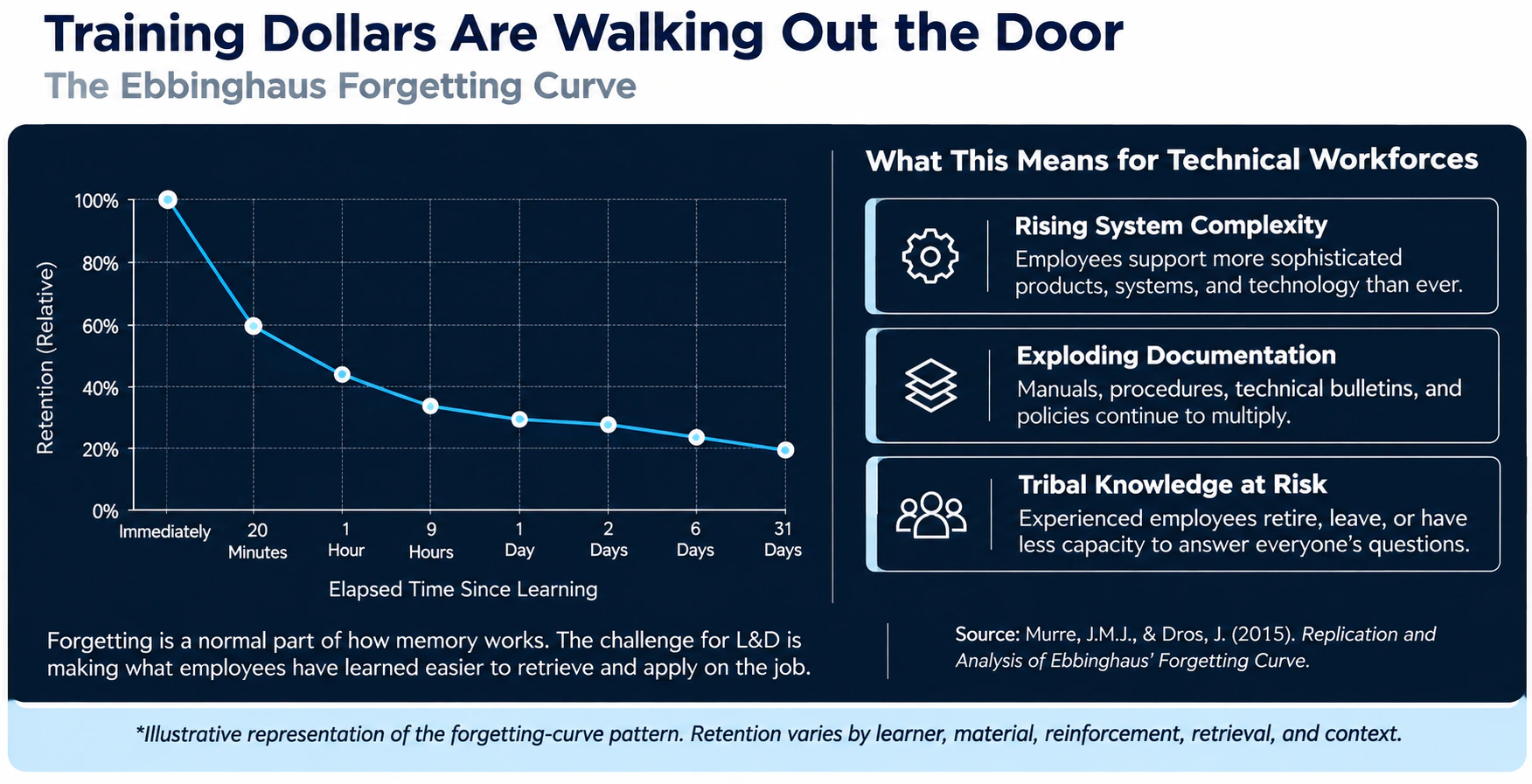
Source: Murre, J. M. J., & Dros, J. (2015). Replication and Analysis of Ebbinghaus' Forgetting Curve. PLOS ONE, 10(7), e0120644.
This graphic is an illustrative representation, not a universal empirical retention curve or a workplace-training benchmark. Its plotted percentages are not universal findings from Murre and Dros; their replication used the method of savings in relearning.
For L&D leaders, the important point is not whether an employee remembers a specific percentage after a certain number of days.
The important point is simpler:
People cannot permanently retain every detail they encounter in training.
The modern workplace makes that problem more difficult.
Rising system complexity
Employees are supporting more sophisticated products, equipment, software, processes, and customer environments.
Exploding documentation
Manuals, procedures, technical bulletins, policies, product updates, knowledge articles, and training materials continue to accumulate.
Tribal knowledge at risk
Some of the organization's most valuable knowledge still resides with experienced employees. When those employees retire, leave, change roles, or become overloaded, the organization can lose access to knowledge that took years to build.
That shifts the question for L&D.
Instead of asking only, “How do we train employees on more?” organizations also need to ask:
How do we make what they have already learned, and what the organization already knows, easier to access when they need it?
Your Employees Cannot Remember Everything. They Shouldn't Have To.
Consider a few common situations.
A field technician was trained on a particular piece of equipment but has not encountered that model in nine months.
A customer service representative remembers the standard policy but encounters an uncommon exception.
A manufacturing employee needs to perform a procedure that only occurs a few times each year.
A medical-device technician recognizes the general problem but cannot recall the exact troubleshooting sequence.
A new employee understands the fundamentals but encounters a situation that received only a few minutes of attention during onboarding.
These situations may look like training problems. Sometimes they are.
In other cases, the employee has already been trained and the information already exists. The challenge is finding the right information quickly enough to use it.
That distinction matters.
The Gap Between Training and Performance
Most organizations have good visibility into training activity.
They know who enrolled, who attended, who completed a course, and who passed an assessment.
Those measures are useful, but they do not tell the whole story.
The business value of training appears when an employee can use what they learned to perform the job more effectively.
A typical path looks something like this:
Training delivered → Knowledge acquired → Time passes → Real work happens
At that point, one question becomes critical:
Can the employee retrieve the knowledge they need?
If they can, they apply it and continue working.
If they cannot, they may start searching through manuals, SharePoint sites, training systems, old emails, or technical documentation. They may call a senior employee or escalate to a manager. In some cases, they may delay the work or make an avoidable mistake.
Across a large workforce, those moments add up.
They can contribute to:
- Longer task completion times
- More technical escalations
- Interruptions to senior employees
- Slower new-hire development
- Inconsistent execution
- Rework or repeat visits
- Customer delays
- Lower productivity
- Greater dependence on a small number of experienced employees
This is why learning transfer matters.
CIPD's Learning at Work research has highlighted the importance of moving beyond learning activity and focusing more closely on whether learning transfers into workplace performance.
Your LMS Did Its Job. Now What?
This is not an argument against formal training.
Employees still need structured learning to develop foundational knowledge, judgment, hands-on skills, safety practices, product understanding, professional capability, and certifications.
Learning Management Systems remain important for organizing, delivering, tracking, and assessing that learning.
The challenge changes when the employee returns to work.
At that point, the question is no longer simply:
What course did this employee complete?
It becomes:
Can this employee find the correct information quickly enough to perform the job?
That is the last mile between learning and performance.
Retraining someone every time they forget a specific detail is rarely practical. The better approach is to combine strong training with easy access to trusted information.
Training answers:
What should this employee learn?
Point-of-need knowledge answers:
What does this employee need to know right now?
Both are important.
From Training Delivery to Knowledge Availability
A great deal of the knowledge employees need already exists inside the organization.
It may be spread across:
- Training materials
- Standard operating procedures
- Equipment manuals
- Policies
- Job aids
- Troubleshooting guides
- Technical bulletins
- Product documentation
- FAQs
- Knowledge articles
- Service procedures
- Lessons learned
The challenge is often not creating more information.
It is helping employees find the right information quickly enough to change the outcome.
A more complete learning model looks like this:
Train → Reinforce → Retrieve → Apply → Measure
That is where AI can become useful.
The Opportunity Is Trusted Retrieval in the Flow of Work
Generative AI has made it easy to ask a question and receive an answer.
For technical, regulated, safety-sensitive, or customer-facing work, however, a plausible answer is not enough.
Employees need to know whether the answer is based on information their organization trusts.
A source-grounded AI Answer Desk addresses that problem by allowing employees to ask natural-language questions across selected organizational knowledge and receive responses grounded in approved source material.
Employees can then review where the answer came from and consult the original source when necessary.
A useful system should provide four things.
Approved knowledge
The organization controls which training, technical, policy, process, and operational materials are included.
Source-grounded answers
Responses are connected back to their original sources so employees can verify the information.
Access during the work
Employees can retrieve knowledge when they encounter the situation, rather than only when they happen to be inside a course or knowledge system.
Learning intelligence
The questions employees ask provide another source of information about what they struggle to remember, locate, or apply.
That last point may be especially valuable to L&D.
What If Employee Questions Became L&D Data?
Imagine learning that hundreds of technicians repeatedly ask about the same troubleshooting procedure.
Or that new customer service representatives regularly struggle with the same policy exception.
Perhaps employees repeatedly search for a procedure that exists, but is buried across several documents.
Maybe employees are asking questions for which the organization has no approved answer at all.
Those questions tell you something.
They can reveal:
- Knowledge that is difficult to retrieve
- Training topics that may need reinforcement
- Procedures that consistently create confusion
- Documentation that is incomplete or inconsistent
- Employee groups that need additional support
- Knowledge employees actually need after training ends
This creates the possibility of a useful feedback loop:
TRAIN → WORK → ASK → ANSWER → ANALYZE → IMPROVE
L&D teams already know what employees were assigned and what they completed.
The next level of insight is understanding what knowledge employees actually need once they return to work.
AI Adoption Should Show Up in Performance
Many organizations now have goals related to AI literacy, AI adoption, workforce transformation, and productivity.
Training employees about AI is important, but it is different from using AI to improve everyday work.
A stronger AI adoption story may be:
Employees are using approved AI tools to perform their jobs more effectively.
For L&D, that can connect learning strategy with real operational use.
The right question is not simply how many employees logged into an AI tool.
It is:
What changed because employees had better access to knowledge?
Measure the Last Mile
If point-of-need knowledge is going to create business value, the measurement should extend beyond usage.
Depending on the role and industry, useful measures may include:
Time to proficiency
How long does it take a new employee to work independently?
Time to trusted answer
How long does an employee spend searching before finding approved information?
Escalation rate
How often does an employee need another person to provide the answer?
Senior-expert interruptions
How much time do experienced employees spend answering questions that existing knowledge could resolve?
Knowledge gaps
Which questions cannot be answered confidently using current organizational content?
Quality and rework
Does better knowledge access affect errors, repeat work, callbacks, or quality?
Service performance
Where relevant, does it influence resolution time, first-time-fix rate, customer response time, or another operational measure?
The goal is not to prove that employees used the AI.
The goal is to determine whether better access to knowledge changed performance.
Five Questions for L&D Leaders
Before investing in another learning technology, ask:
- After employees complete training, where do they go when they cannot remember something?
- How long does it take them to find the correct answer?
- Who gets interrupted when they cannot find it?
- Which knowledge gaps create the most operational friction?
- Can L&D currently measure those moments?
If those questions are difficult to answer, there may be an opportunity between your learning platform and the point where employees actually perform the work.
Is There Still One 2026 Learning Goal You Need to Move?
For many L&D leaders, the 2026 scorecard is not finished yet.
The remaining objective may involve workforce readiness, training effectiveness, AI adoption, technical proficiency, new-hire ramp time, productivity, or learning transfer.
Six weeks is probably not enough time for another large transformation program.
It is enough time for a focused experiment.
MachOne Consulting can prepare a focused AI Answer Desk using an organization's existing approved knowledge in approximately seven days, followed by a 30-day pilot with a defined employee group.
Start small:
One employee population.
One body of trusted knowledge.
One measurable performance problem.
Then measure the result.
Start With One Measurable Win
The future of L&D is not simply about producing more content.
It is about connecting learning more closely to performance.
Training still teaches the fundamentals. Practice develops judgment. Managers coach. Experienced employees remain invaluable.
What employees should not be expected to do is memorize every product specification, procedure, policy, technical bulletin, exception, and troubleshooting step their organization has ever taught them.
They need a reliable way to recover trusted knowledge when the situation requires it.
Training teaches it. Make sure employees can retrieve and apply it when the business needs it.
Explore a 30-Day AI Answer Desk Pilot
7 days to ready 30 days to measure One defined employee population One measurable business outcome
Explore a 30-Day AI Answer Desk PilotIf there is not a credible path to measurable business value, don't scale it.
Frequently Asked Questions
What is the Ebbinghaus forgetting curve?
The Ebbinghaus forgetting curve describes the general tendency for learned information to become harder to recall as time passes without reinforcement or retrieval. Modern research has replicated the general pattern, although exact retention rates vary considerably based on the learner, material, context, and methodology.
How quickly do employees forget training?
There is no universal percentage or timeline that applies to every employee or type of training. Retention depends on prior knowledge, relevance, practice, reinforcement, retrieval, learning design, and how frequently the knowledge is used.
The practical lesson is that employees should not be expected to permanently recall every detail presented during training.
What is learning transfer?
Learning transfer is the application of knowledge or skills developed through training to actual workplace performance.
For most organizations, the value of learning ultimately depends on whether employees can use what they learned to perform more effectively.
What is point-of-need learning?
Point-of-need learning makes relevant information or guidance available when an employee encounters a situation that requires it.
It complements formal training by helping employees retrieve specific knowledge during actual work.
Can AI improve employee training?
AI can support learning by helping employees retrieve approved knowledge, reinforce previously learned material, identify recurring knowledge gaps, and make existing learning resources easier to access.
Its value depends on whether those capabilities lead to better workplace performance.
What is an AI Answer Desk?
An AI Answer Desk is a source-grounded knowledge system that allows employees to ask natural-language questions across approved organizational content such as training materials, manuals, procedures, policies, and technical documentation.
Responses are connected to underlying source material so employees can verify the information.
Can an AI Answer Desk replace an LMS?
No.
An LMS and an AI Answer Desk serve different purposes.
An LMS manages structured learning, courses, assessments, and completion.
An AI Answer Desk can complement that infrastructure by helping employees retrieve and apply approved knowledge while they are working.
How can L&D leaders measure training ROI?
Training ROI should connect learning activity to changes in workplace performance.
Depending on the use case, useful measures may include time to proficiency, knowledge-retrieval time, escalation rates, senior-employee interruptions, error or rework rates, service resolution, productivity, or other operational outcomes.
How can AI help employees apply training in the workplace?
Source-grounded AI can make relevant training materials, procedures, documentation, and organizational knowledge easier to retrieve when employees need them.
This can help close the gap between what employees were taught and what they can recall during real work.